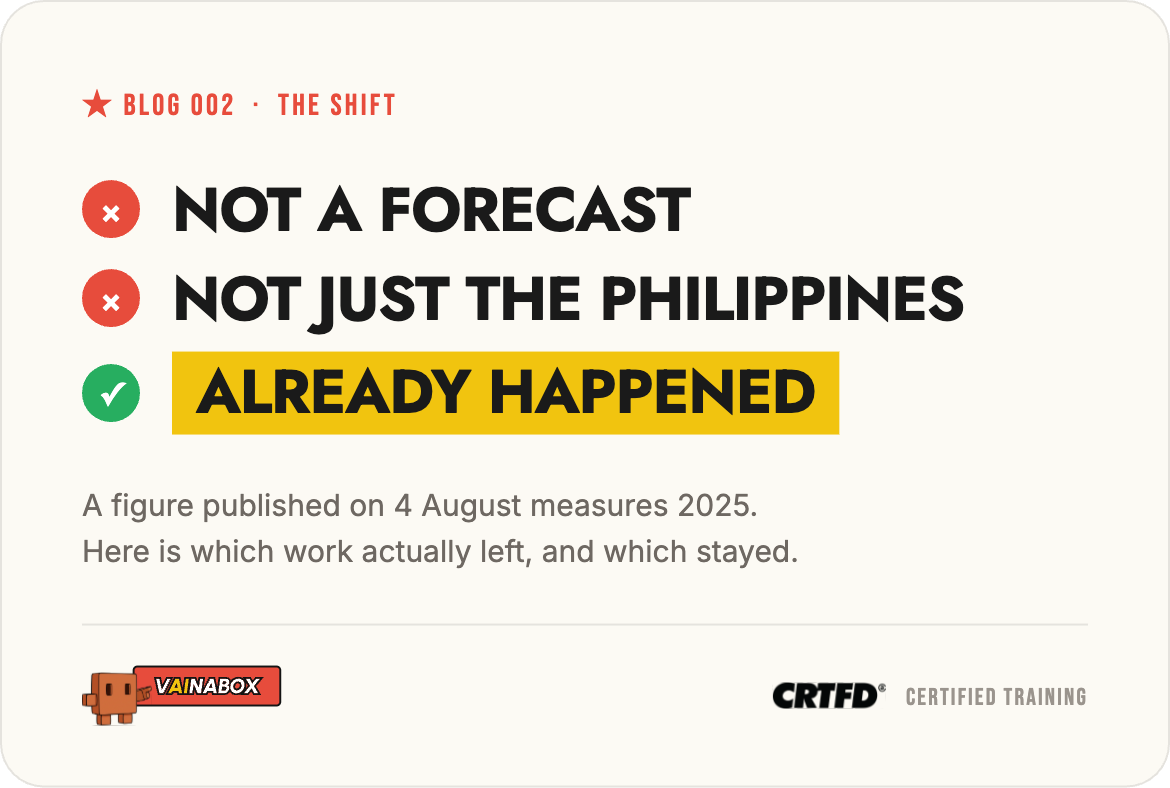
On 4 August the World Bank published its World Development Report 2026: The Promise of Artificial Intelligence.¹ According to the publications that covered the launch, Manila Bulletin here and Business Standard in India, it contains a figure worth knowing about: a major online freelance platform saw jobs outsourced to developing economies fall 39% in 2025.²
It may not have crossed your feed. It did not get much coverage here. But it happened, and it is worth understanding properly.
Much of the conversation about AI and Filipino online work has been forecast. Predictions, exposure models, warnings about what was coming. This is different. This is a measurement of a year that has already finished, and you worked through it.
So: what the number says, what it does not, what it means for the kind of work you do, and where things actually stand now.
What the number says
Four things in that sentence carry weight.
- One platform Not the market. Not every platform. One, and none of the coverage names it.
- Developing economies Not the Philippines. A category covering dozens of countries.
- In 2025 Last calendar year. Finished.
- A measurement Something that happened, not a projection of something coming.
What it does not say
It does not say 39% of Filipino VA work disappeared. Two errors have to be stacked to reach that sentence: swapping developing economies for the Philippines, and swapping work outsourced for jobs lost. The figure counts work sent to a platform, not people employed. Those move together sometimes. They are not the same measurement.
It is also not a prediction. Any forward-looking analysis built on top of it is a different claim and should be read as one.
And it sits alongside the report's own headline estimates, which point a gentler way for countries like ours. The World Bank puts 4.5% of existing jobs in low- and middle-income countries at risk from AI, against 14.2% in high-income countries, and estimates 16.2% of jobs in developing economies could see productivity meaningfully boosted by it.¹ The exposure is real. It is also lower here than in the rich economies doing most of the worrying.
Which 39% left
That is the question the number cannot answer on its own, so here is how we would think about it.
If you can describe a task completely in one sentence, and someone could do it correctly without knowing anything about the business, that task was always the most exposed.
- Sort this inbox by sender.
- Type these receipts into the spreadsheet.
- Transcribe this call.
- Schedule these posts at these times.
That is real work and people were paid honestly to do it. But it is describable work, and describable work is what a model does well.
Now look at what is left over. Reading a brief and noticing what the client did not say. Knowing which version of the email is technically correct but will land badly with this particular customer. Working out that the thing you were asked for is not the thing that will help, and coming back with both. Telling a client no.
None of that fits in one sentence, and none of it can be handed to someone who does not understand the business.
That is not a consolation prize. It was always the expensive part of the job. For years it came bundled with the describable work, and the describable work was what you invoiced by the hour. The bundle came apart. What is left is the half that was always worth more.
Where things actually stand
On 14 August, ten days after the report, Arsenio Balisacan, Secretary of the Department of Economy, Planning and Development, told the EJAP Economic Forum that concerns the Philippines could lose a substantial portion of its IT-BPM industry because of AI appear exaggerated, given the sector continues to expand.³
On the demand side, Upwork's In-Demand Skills 2026, published 4 February and based on freelancer earnings on its marketplace across the 2025 calendar year with demand originating in the United States, has General Virtual Assistance ranked first in Customer Service and Admin Support. Not a surviving category. First. The same report has skills tied to applying AI inside an existing role growing 109% year on year.⁵
And Upwork's Future Workforce Index 2026, published 14 July from a survey of 2,400 US-based skilled workers alongside platform data, found freelancers doing AI work earn 34% more per hour than those who do not.⁶ That is market context, not a promise, and we will not dress it up as one. But it points the same way as everything above it.
What genuinely did change
Plenty. This is not a story where nothing happened.
On 15 July, IBPAP revised its own 2028 targets down. Revenue from $59 billion to a range of $43.3 to $50.5 billion. Employment from 2.5 million to between 1.85 and 2.14 million. Depending on where the range lands, that is somewhere between 360,000 and 650,000 jobs taken off a target set by the industry's own association, not by a critic.⁴
Jack Madrid, IBPAP president and CEO, said the entry-level employees affected by AI trials have been able to be redeployed, and that widespread job losses have not materialised.⁴ That should be said. But nobody revises a target down by hundreds of thousands of people because nothing is happening. And the revision came with a condition attached, two words long: employees are to be AI-enabled. That is the entry requirement, written down by the industry's own body.
Capital Economics separately puts around one million Philippine BPO roles as potentially vulnerable to automation by 2030.⁷ That is a third-party projection quoted in coverage of Balisacan's remarks, not his own figure, and four-year forecasts have a patchy record. It belongs here anyway, because leaving it out would make this a comfortable article instead of an honest one.
The honest reading is not that the work is going. It is being repriced. Describable work is being priced down. Judgment work is what is left, and on the numbers above it is what the market is paying up for.
What to look at now
- Audit your own week. Write down what you did for five working days, task by task, then mark every one you could describe fully in a single sentence. That proportion tells you more about your own position than any headline figure will.
- Learn the tools on your existing work. Take something you already do well and run it through an AI tool badly, then better, then properly. You are not learning the software. You are learning where its output is wrong, and that is the entire skill.
- Stop hiding it. Plenty of VAs already use AI and say nothing, because they worry it reads as cheating. On the market data, it is priced up, not down.
- Get specific. General Virtual Assistance ranking first is good news for anyone who has a second thing standing next to it. Ecommerce, medical, research, systems, automation. The bar moved from "can you do the tasks" to "can you run the function."
The 39% is on the record, and it measures a year you already got through. The question was never whether the work would change. It is whether you would be one of the people it changed for.
Sources
- World Bank, World Development Report 2026: The Promise of Artificial Intelligence, released 4 August 2026. Title and date on the World Bank publication page. The 4.5%, 14.2% and 16.2% estimates are from the press release, 4 Aug 2026.
- The 39% figure appears in launch-day reporting: Manila Bulletin, 4 Aug 2026 and Business Standard, 4 Aug 2026. Neither names the platform.
- Arsenio Balisacan, Secretary, Department of Economy, Planning and Development, at the EJAP Economic Forum, 14 August 2026. Manila Bulletin, 14 Aug 2026
- IBPAP 2028 target revision, 15 July 2026. Revenue $59B to $43.3-50.5B; employment 2.5M to 1.85-2.14M, conditional on employees being AI-enabled. Inquirer, 15 Jul 2026
- Upwork, In-Demand Skills 2026, 4 February 2026. Marketplace freelancer earnings across six categories, Jan-Dec 2025, US-origin demand. Upwork Inc.
- Upwork, Future Workforce Index 2026, 14 July 2026. Survey of 2,400 US-based skilled workers, Mar-Apr 2026, plus platform data. Upwork Inc.
- Capital Economics, cited in Manila Bulletin’s 14 August 2026 coverage: around one million Philippine BPO jobs potentially vulnerable to automation by 2030. A third-party projection, not a DEPDev figure.